Billiard hall management software built for Philippine pool halls
CuePoint is built in the Philippines for the way local billiard halls actually run: late nights, mixed table layouts, cash-heavy checkout, staff handoffs, and owners who need clear daily numbers.
Free plan available. No credit card required.
Why Philippine billiard halls need more than a generic POS
Philippine billiard halls do not always operate like Western pool rooms. Many halls run late into the night, especially on weekends, and the busiest hours often happen when owners are not standing beside the cashier. Staff handle walk-ins, regulars, barkada groups, food and drink orders, and table transfers while trying to keep a written log accurate. A generic POS can record a payment, but it does not understand that a table has been running for 1 hour and 37 minutes and still has drinks attached to the same group.
Mixed table layouts are common. A hall may have standard pool tables, one or two snooker tables, a premium table, and a smaller practice area with a different price. Those tables should not all bill the same way. In a manual setup, the cashier must remember which rate applies, whether a promo is active, and how to round the session. On a busy night in Ilocos Norte or Pampanga, that is exactly where undercharging starts: a table that should be billed at a higher rate gets treated like the standard table because the staff member is rushing.
Cash remains central to many local operations. Some customers pay cash, some pay by transfer or wallet, and some split payments after a group session. CuePoint supports cash checkout and custom payment method labels so the hall can record the method used. A label such as GCash can be added if the hall accepts it outside CuePoint, but CuePoint does not currently process GCash payments or act as a wallet integration. That distinction matters: the cashier still confirms the external payment, then records the method in CuePoint for reporting.
Operating currency is also separate from subscription billing. A Philippine hall can run its daily operations, receipts, and reports in the currency it uses at the counter, while CuePoint subscription checkout remains controlled by the online payment provider. The software should not imply PHP subscription billing unless that is what the provider presents and charges at checkout. This separation keeps customer-facing hall operations practical while keeping software billing accurate to what the payment provider actually charges.
The old way creates owner blind spots. A logbook may show start and end times, but it rarely shows product sales, payment method, staff action, voids, membership activity, and table utilization in one place. By closing time, the cashier has a stack of notes, a cash count, and a rough idea of what happened. If the totals are wrong, the owner has to guess whether the problem came from missed minutes, a wrong rate, unrecorded snacks, or a shift handoff mistake.
Late-night operations make this worse. A hall that opens in the afternoon and closes after midnight has long shifts, handovers, tired staff, and customers who may move tables or add orders several times. The owner needs a system that keeps time and checkout records consistent without asking every cashier to be perfect. Manual tracking can work for a very small setup, but it becomes fragile as soon as more tables, staff, and products are involved.
How CuePoint supports how local billiard halls run
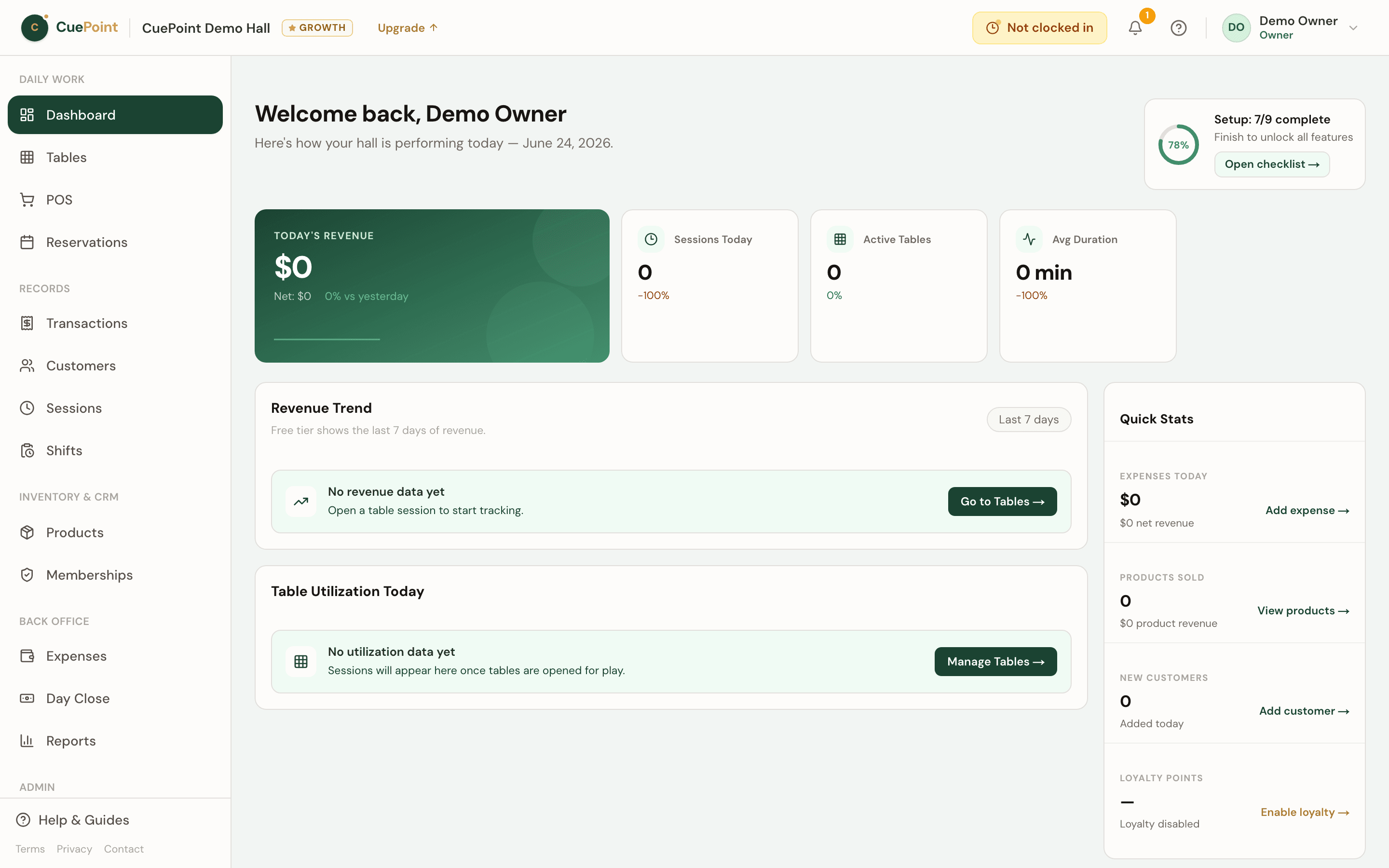
CuePoint gives Philippine operators a browser-based floor view where every table has a clear status. Staff can see which tables are available, active, paused, or reserved, plus the running time for active sessions. When a table starts, the timer runs on our servers and the rate rules you set apply. When the session ends, checkout combines table time with product orders so the cashier is not switching between a notebook, calculator, and register.
Rate setup is flexible enough for local hall realities. You can set different rates for standard pool tables, snooker tables, VIP tables, or promo schedules. Rounding rules and minimum charges help protect revenue on short sessions. For example, a Pampanga hall might set a 30-minute minimum for premium tables and a different weekday promo for standard tables before peak evening hours. Staff do not need to memorize every rule because CuePoint applies the setup you chose at checkout.
The POS supports the counter items many halls sell: drinks, snacks, cue rentals, accessories, membership payments, and other products. These items can be added during the session and settled together with table time. If inventory tracking is enabled, stock can be deducted as products are sold. That means the owner can later see whether revenue came from table sessions, product sales, or other activity instead of relying only on the cash drawer total.
Custom payment labels let the hall record how customers paid without claiming direct payment processing. If your cashier receives cash, mark cash. If the customer pays through a wallet or transfer outside CuePoint, confirm the payment through your normal process and record the matching label. This gives the owner a clearer end-of-day breakdown while keeping the real payment confirmation in the channel the hall already uses.
CuePoint is Philippines-built and support is handled from the Philippines timezone. That does not mean the product only works in the Philippines, but it does mean local operating patterns are not an afterthought. A small hall in Ilocos Norte can ask practical setup questions without explaining why cash checkout, late-night shifts, and mixed table types matter. Support can help translate those real-world rules into table rates, roles, products, and reports.
A realistic day looks like this: the hall opens at 2 PM and staff start with four available tables. By 6 PM, two barkada groups are playing pool, one regular is on the snooker table, and a reserved table is due at 8 PM. Staff add bottled drinks to Table 2, pause Table 3 while players step out, and transfer one group to a better table after maintenance. At checkout, CuePoint calculates the active time, applies the correct rate, includes the product orders, and records whether payment was cash or another custom label.
At the end of that shift, the owner can review actual numbers instead of reconstructing the night from memory. Table revenue, product sales, voids, and utilization are based on completed records. If a staff member made a correction, the void remains visible rather than disappearing. If a table was underused, the utilization report shows it. This is the difference between a tool that only takes payments and a system that explains how the hall operated.
CuePoint also gives new operators a low-risk starting path. The Free plan is available for a small setup, and operators who need to test higher limits can use the Pro trial before deciding on a paid plan. The right next step is not to migrate everything on day one. Start with tables, rates, staff, and your most common products, then run real sessions until the routine feels natural.
Cash, GCash labels, mixed table types, and late-night operations
Built for how Philippine halls run
Late-night shifts, mixed table types, walk-ins, reservations, cash checkout, and practical staff handoffs are treated as normal operations.
Cash and custom payment labels
Record cash, card, bank transfer, GCash, Maya, or other labels your hall uses. CuePoint records the method but does not process wallet payments.
Local operating currency support
Run customer checkout and reports in your hall's operating currency while software subscription billing stays at the price the checkout shows.
Philippines timezone support
CuePoint support is handled from UTC+8, making setup questions easier for Philippine operators.
Free plan and Pro trial
Start with the Free plan for a small setup or test higher limits with the 14-day Pro trial before choosing a paid plan.
Billiard hall software Philippines FAQs
Start running your Philippine billiard hall with CuePoint
Create your account, then choose Free or try Pro for 14 days.
More billiard hall software use cases
Billiard hall POS system for table time and checkout
CuePoint combines table time billing and food, drinks, and rental orders into one POS checkout screen built for billi...
Pool table time tracking software for billiard halls
CuePoint helps billiard halls track pool table time accurately, apply table rates automatically, and send final charg...
Billiard hall revenue reports and table utilization software
See your real daily revenue immediately: table sessions, product sales, and memberships broken down clearly. No end-o...
Billiard hall cash drawer and day close software
Open with a float, track every transaction, count the drawer, and close with the variance flagged. CuePoint replaces ...
Pool hall management software for tables, POS, and daily ...
CuePoint is pool hall software that combines table session tracking, POS checkout, reservations, and revenue reports ...
Billiard hall staff management software with roles and au...
Owner, manager, and staff roles enforced on the server, with email invites, shift clock-in, and audit history. Run yo...