Billiard hall cash drawer and day close software
CuePoint tracks cash from opening float through every sale, refund, and paid-out. Count the drawer at close and see the variance instantly. No calculator, no guessing.
Free plan available. No credit card required.
Why end-of-day cash counts fall short in billiard halls
Most billiard halls close the day with a cash count and a prayer. The cashier counts what’s in the drawer, compares it to receipts or a notebook total, and calls it close enough. If the numbers are off, nobody knows whether the gap came from a missed session, a wrong change, an unrecorded snack sale, or something worse.
Shift handovers make it harder. When two or three cashiers share a day, nobody owns the full picture. The morning cashier opens with one float, the afternoon cashier adds another, and by closing the owner is reconciling across people who aren’t there anymore.
Without a structured day-close process, cash discrepancies become a recurring mystery. The owner either absorbs the variance or accuses staff without evidence. Neither builds trust, and neither stops the problem from repeating.
How CuePoint tracks cash from opening float to day close
CuePoint gives every operating day a clear lifecycle: open, run, and close. Staff open the day with a counted float. From that point, every cash sale, refund, and paid-out flows into the expected drawer balance automatically. The system knows exactly what should be in the drawer at any moment.
When cashiers change mid-shift, a handover count records the state of the drawer at the transition. The incoming cashier starts with a verified number, not an inherited guess. Each shift segment has its own accountability.
At close, staff count the physical drawer and enter the total. CuePoint compares expected versus counted and flags the variance. A full Z-report snapshot is saved with every close: revenue breakdown, payment methods, voids, and the variance figure. Past days stay open until an owner or manager explicitly closes them, so nothing gets swept under the rug.
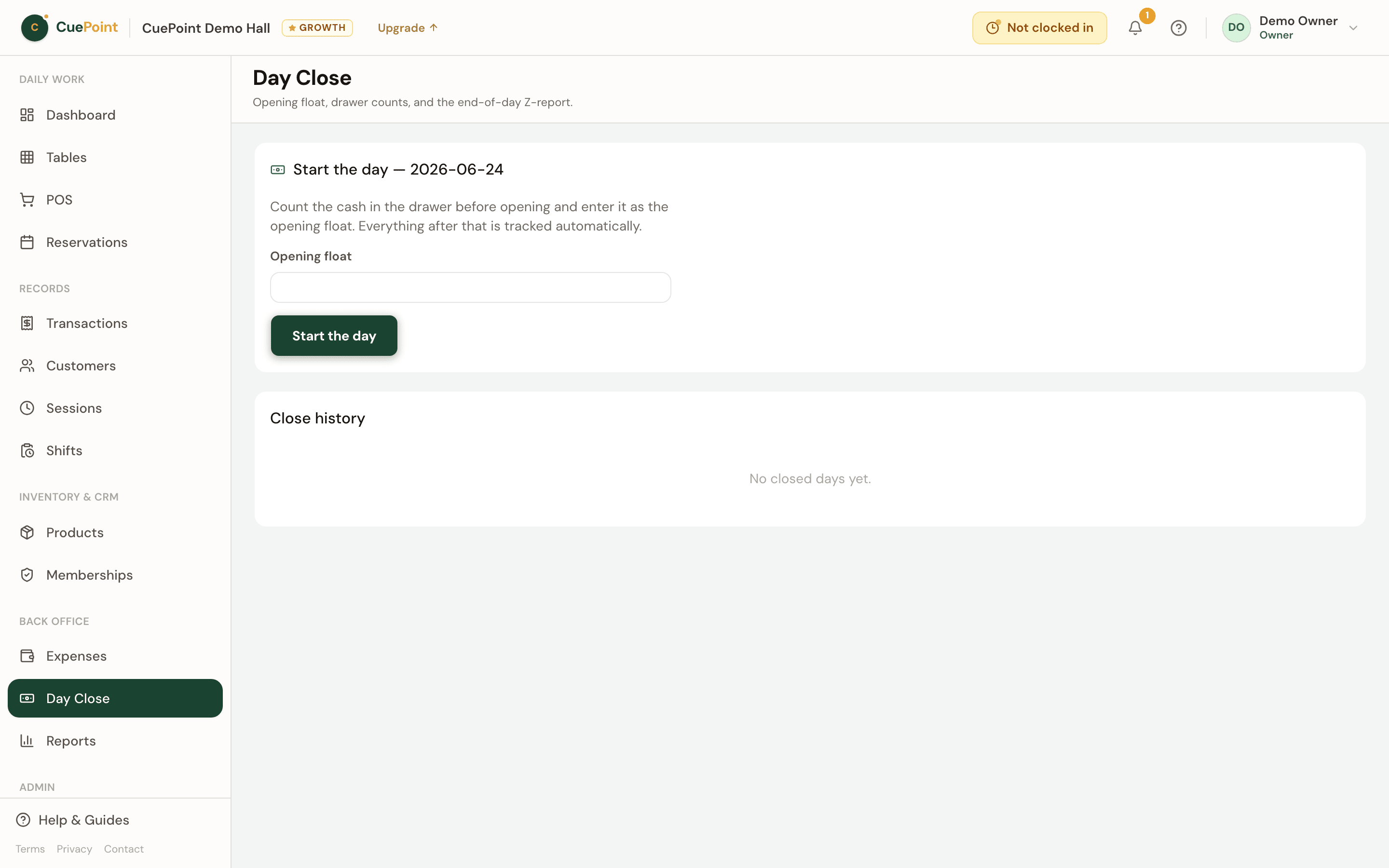
Cash drawer, shift handover, and variance features
Opening float
Start each day with a counted float. The system tracks from that baseline forward.
Automatic drawer tracking
Cash sales, refunds, and paid-outs flow into the expected balance. No manual ledger.
Shift handover counts
Record the drawer state when cashiers change. Each shift has its own accountability.
Variance on close
Count the drawer, enter the total, and see expected vs counted with the variance flagged immediately.
Z-report snapshot
A full day summary is saved at close (revenue, payment methods, voids, and variance) and can’t be edited after the fact.
Billiard hall cash drawer FAQs
See how CuePoint handles your end-of-day close
Create your account, then choose Free or try Pro for 14 days.
More billiard hall software use cases
Billiard hall POS system for table time and checkout
CuePoint combines table time billing and food, drinks, and rental orders into one POS checkout screen built for billi...
Billiard hall revenue reports and table utilization software
See your real daily revenue immediately: table sessions, product sales, and memberships broken down clearly. No end-o...
Billiard hall open tab software: park sales and settle later
Let regulars run a tab all night. CuePoint tracks every item, keeps stock accurate, and settles in one step at closin...
Billiard hall staff management software with roles and au...
Owner, manager, and staff roles enforced on the server, with email invites, shift clock-in, and audit history. Run yo...